
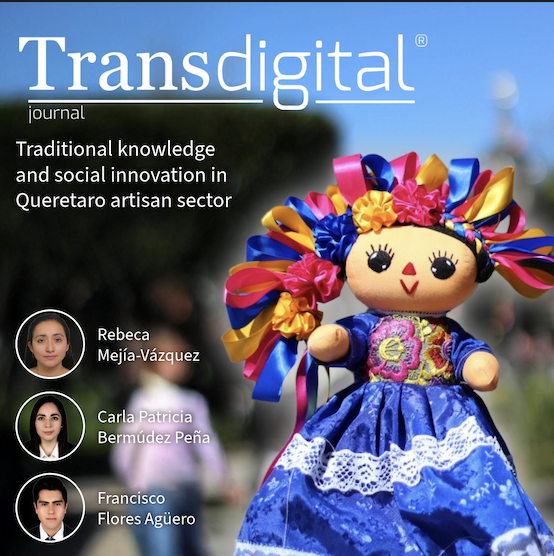
Traditional knowledge and social innovation in Queretaro artisan sector
DOI:
https://doi.org/10.56162/transdigital581Keywords:
handicraft, knowledge, social innovation, artisan sectorAbstract
The aim of this article was to analyze the transmission of traditional knowledge and its link to social innovation, focusing on how this transmission is carried out in artisan workshops in the municipalities of Querétaro, Mexico. The research approach was qualitative, employing interviews in 12 workshops. These workshops were selected based on three criteria: 1) that they sold their crafts; 2) that they accepted tours or visits to their workplaces; and 3) that they had received some form of recognition (either for the artisan or their crafts). Familiarization visits were also conducted, and both participant and non-participant observation were used. In this context, it was identified that, for the preservation of artisanal knowledge, other methods of transmitting this knowledge have been integrated. While it is primarily transmitted from generation to generation, workshops have incorporated options such as opening learning and teaching schools, and apprentices are considered part of the community (even if they do not belong to artisan families). Based on the above, the characteristics associated with social innovation were co-creation, social empowerment, agency, and the creation of learning spaces. These aspects fostered innovation in the areas of product, process, marketing, and management. Furthermore, they promoted a shared worldview, the transmission of knowledge (with an emphasis on tacit and traditional knowledge), and public policies regarding the artisan sector.
References
Abeledo, R., Coli, V., & Koster, P. R. (2016). La cultura como factor de innovación socioeconómica en el medio rural: el caso del clúster de artesanía artística de La Cittá Europea del mestiere d´Arte (CITEMA). Ager. Revista de Estudios sobre Despoblación y Desarrollo Rural, (20), 73-103.
Alexandre, B., Salguero, J., Peralta-Álvarez, M. E., Aguayo-Gonzalez, F., & Ares, E. (2017). Aplicación de las tecnologías de la industria 4.0 al diseño y fabricación de productos artesanales. Economía del cambio tecnológico, 92(4), 435-441. http://dx.doi.org/10.6036/8169
Bloch, C. (2007). Assessing recent development in innovation measurement: the third edition of the Oslo Manual. Science and Public Policy, 34(1), 23-34.
Chacón Martínez, M. C., & Gaona León, C. (2021). Estrategia para la innovación en el proceso de comercialización de artesanías de barro del municipio de Ráquira. In Vestigium Ire, 14(2). 81-105. https://revistas.santototunja.edu.co/index.php/ivestigium/article/view/2236
Correa García, L. Á., & González Acolt, R. (2017). Efecto de los factores de innovación en el desempeño económico de los talleres artesanales de la zona metropolitana de Zacatecas. Investigación y Ciencia de la Universidad Autónoma de Aguascalientes, (70), 63–68. https://doi.org/10.33064/iycuaa2017701829
Cuéntame de México. (s.f.). Usa la estadística y la geografía para escribir México. División territorial-Querétaro. Página web oficial de Cuéntame de México. https://cuentame.inegi.org.mx/imprime_tu_mapa/default.html
Del Carpio, P. S. (2016). Estrategias mercadológicas e innovación en las artesanías, una tradición transformadora. Poliantea, 12(23), 77-110. https://doi.org/10.15765/plnt.v12i23.987
Echevarría, J. (2008). El Manual de Oslo y la innovación social. Arbor, 184(732), 609–618. https://doi.org/10.3989/arbor.2008.i732.210
Estensoro, M. (2015). How can social innovation be facilitated? Experiencies from an Action Research Process in a Local Network. Systemic Practice and Action Research, 28(6).
FONART. (2020). Diagnóstico situacional del sector artesanal en México durante el período de la pandemia por el Covid-19. Fondo Nacional para el Fomento de las Artesanías. https://www.gob.mx/cms/uploads/attachment/file/596992/Diagno_stico_Pandemia_Fonart.pdf
Greenfield, P.-M., & Childs, C.-P. (2005). Aprendiendo a tejer en Zinacantán. Un estudio de dos décadas sobre el cambio histórico en la educación informal. Infancia y Aprendizaje, 28(1), 3-24. https://doi.org/10.1174/0210370053125489
INEGI. (2023). Estadísticas a propósito del Día Internacional del Artesano. Página web oficial de Instituto Nacional de Estadística y Geografía. https://inegi.org.mx/app/saladeprensa/noticia/8052
Jaillier-Castrillón, E., Ramírez, L. F., Sampedro, C. A., & Arboleda, C. A. (2020). Innovación social: evolución del concepto en el tiempo. Revista Venezolana de Gerencia, 25(92).
Jaillier, E. (2017). Construyendo la innovación social. Guía para comprender la innovación social en Colombia. Universidad Pontificia Bolivariana.
Martínez, G. (2018). Procesos de aprendizaje del conocimiento tácito. El caso de un taller de alebrijes. Recherche en Sciences de Gestion, 124(1), 105-129. https://doi.org/10.3917/resg.124.0105
Medina, T. (2025). Riqueza cultural, artesanal y artística queretana traspasa fronteras. Diario de Querétaro. https://oem.com.mx/diariodequeretaro/turismo/riqueza-cultural-artesanal-y-artistica-queretana-traspasa-fronteras-23019537
Méndez Ortiz, E. L. (2017). Batería de indicadores de Innovación Social. Corporación Universitaria Minuto de Dios.
Morales Saldaña, A. I., Landa Alemán, Á. A., & Arellano Calva, E. (2025). Héritage: un proyecto didáctico con Canva para divulgar el patrimoniocultural francés en San Rafael, Veracruz, México. Transdigital, 6(11), e436. https://doi.org/10.56162/transdigital436
Muñoz-Rojas, T., Giraldo-Builes, J., & López-Gómez, M. del S. (2019). Mecanismos de protección de los conocimientos tradicionales: el caso de Colombia. Revista Derecho del Estado, (43) 235–264. https://doi.org/10.18601/01229893.n43.09
Murray, R. Caulier-Grice, J., & Mulgan, G. (2010). The open book of social innovation: ways to design, develop and grow social innovation. The Young Foundation.
Pérez, C. (2019). Dönxu y Lele ya son emblemáticas. Diario de Querétaro. https://oem.com.mx/diariodequeretaro/local/doenxu-y-lele-ya-son-emblematicas-17898323
Rodríguez Herrera, A., & Alvarado, H. (2008). Claves de la innovación social en América Latina y el Caribe. CEPAL.
Saligan Rojas, I. C., Salinas García, V. A., & Del Carpio Ovando, P. S. (2017). Dificultades en torno a la producción artesanal. Jóvenes en la ciencia. Jóvenes en la Ciencia, 3(2). https://www.jovenesenlaciencia.ugto.mx/index.php/jovenesenlaciencia/article/view/1959
Santamaría Aguirre, J. L. (2018). Integración del diseño para el desarrollo del sector artesanal en la providencia de Tungurahua. Revista Chakiñan de Ciencias Sociales y Humanidades, (6), 85-105.
Secretaría de Relaciones Exteriores. (2023). Lele, la muñeca artesanal mexicana que recorre el mundo. Página web oficial del gobierno de México. https://www.gob.mx/sre/prensa/lele-la-muneca-artesanal-mexicana-que-recorre-el-mundo
Tracey, P., & Stott, N. (2016). Social innovation: a window on alternative ways of organizing and innovating. Innovation, 19(1), 51-60.
Ulicka, S., Cruz Villazón, E., & González Hernández, M. (2020). Diseño neortesanal y cultura material significativa. Economía creative, (13), 124-149.
Ulloa-Duque, G. S., Torres-Mansur, S. M., & Placeres-Salinas, S. I. (2023). Contribución de las TIC en el Empoderamiento e Innovación social. Vinculatégica EFAN, 9(6), 93–111. https://doi.org/10.29105/vtga9.6-451
Villalba Morales, M. L. (2022). La emergencia de los sistemas de innovación inclusivos: aportes a su comprensión desde la modelación basada en agentes [Tesis de doctorado, Universidad Nacional de Colombia].
Downloads
Autor de correspondencia
El autor de correspodencia se identifica con el siguiente símbolo: *Published
How to Cite
License
Copyright (c) 2026 Rebeca Mejía-Vázquez, Carla Patricia Bermúdez Peña, Francisco Flores Agüero

This work is licensed under a Creative Commons Attribution 4.0 International License.
All articles in Transdigital are licensed under a Creative Commons Attribution 4.0 International License. Authors hold the copyright and retain publishing rights without restrictions.





