
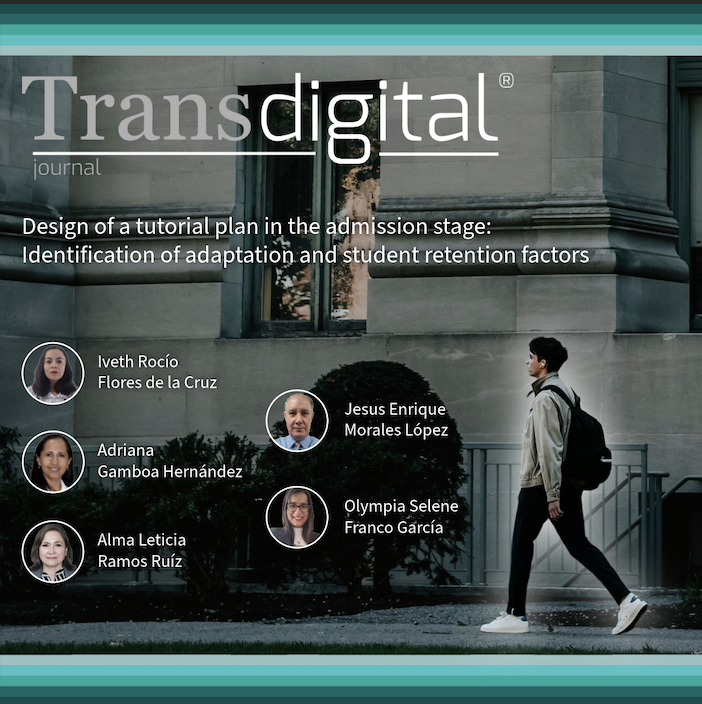
Design of a tutorial plan in the admission stage
Identification of adaptation and student retention factors
DOI:
https://doi.org/10.56162/transdigital522Keywords:
PAT, evaluation, skills, tutorial action planAbstract
This research aimed to maximize the effectiveness of the Tutorial Action Plan (PAT) in the university admissions process for first- through third-semester students. The research focused on the student, pedagogical, and teaching aspects, seeking to strengthen students' essential skills and tools for their academic and future professional development. The goal was to cultivate well-rounded professionals with passion and vocation. The research method consisted of implementing the PAT designed for second- and third-semester students, as well as monitoring and evaluating existing tutoring programs for first-semester students. A specific instrument was used to modify and adjust these tutoring programs to optimize the results. The results indicated that the application of a structured PAT enabled students to acquire key skills for their university and professional training. The process of continuous evaluation and adjustment contributed to improving the students' educational experience, fostering their holistic development. It was concluded that a PAT adapted to the specific needs of each semester and accompanied by constant monitoring could be an effective tool to promote adequate professional and human development in university students.
References
ANUIES. (2001). La educación superior en el siglo XXI: Líneas estratégicas de desarrollo. Asociación Nacional de Universidades e Instituciones de Educación Superior.
Díaz-Barriga, A. (2012). El enfoque de competencias en la educación. ¿Una alternativa o un disfraz de cambio? Perfiles educativos, XXVIII(111).
DGEST. (2012). Modelo educativo para el siglo XXI: Formación y desarrollo de competencias profesionales. Dirección General de Educación Superior Tecnológica. http://www.dgest.gob.mx/director-general/modelo-educativo-para-el-siglo-xxi-formacion-y-desarrollo-de-competencias-profesionales-dp2
Gamboa–Hernández, A., Morales-López, J. E., Flores-De la Cruz, I. R., & Franco-García, O. S. (2024). Initiatives to create a tutorial support plan for new students. Journal-Schools of economic Thought and Methology, 8(14), 1-6. https://doi.org/10.35429/JSETM.2024.8.14.1.6
Romo, A. (2011). La Tutoría. Una estrategia innovadora en el marco de los programas de atención a los estudiantes. Trillas.
SEP. (2019). Modelo educativo para la educación obligatoria. Diario Oficial de la Federación. https://www.sep.gob.mx/work/models/sep1/Resource/15105/1/images/modelo_educativo_educacion_obligatoria.pdf
TecNM. (2015). Manual de Lineamientos Académico–Administrativos del Tecnológico Nacional de México. Secretaría de Educación Públcia. https://irapuato.tecnm.mx/pdf/reglamento/TECNM_Manual_de_Lineamientos_TecNM_SinAnxs.pdf
Tobón, S. (2013). Formación integral y competencias.Pensamiento complejo, currículo, didáctica y evaluación (4ta.Ed.). ECOE.
Downloads
Autor de correspondencia
El autor de correspodencia se identifica con el siguiente símbolo: *Published
How to Cite
License
Copyright (c) 2025 Iveth Rocio Flores de la Cruz, Adriana Gamboa Hernández, Alma Leticia Ramos Ríos, Jesus Enrique Morales López, Olympia Selene Franco García

This work is licensed under a Creative Commons Attribution 4.0 International License.
All articles in Transdigital are licensed under a Creative Commons Attribution 4.0 International License. Authors hold the copyright and retain publishing rights without restrictions.





