
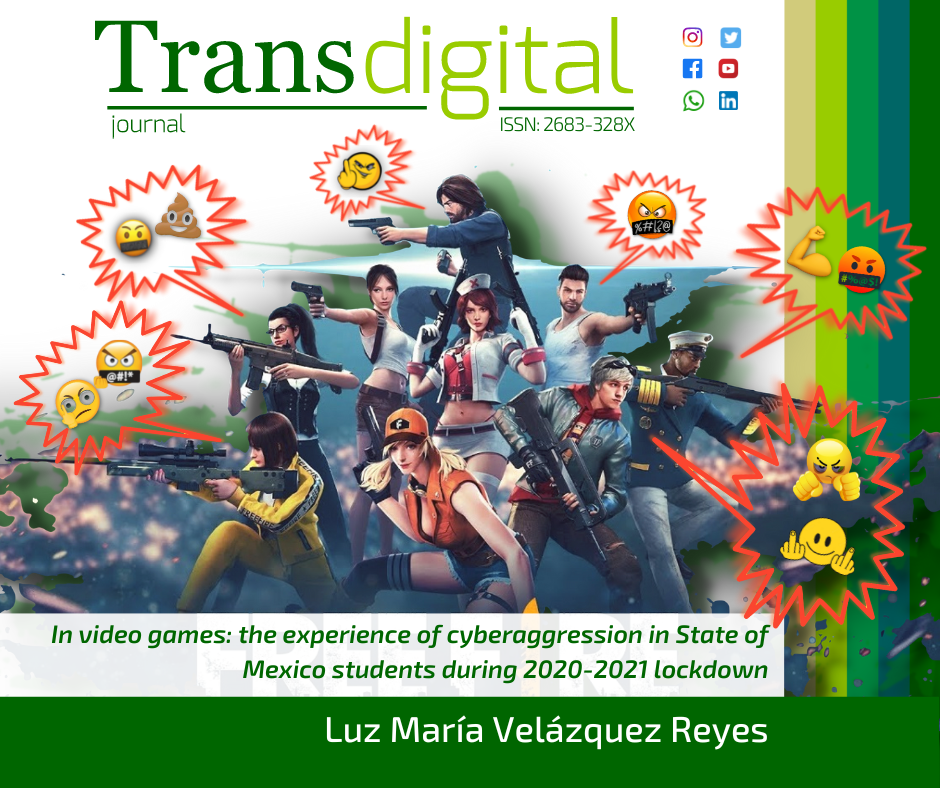
In video games: the experience of cyberaggression in State of Mexico students during 2020-2021 lockdown
DOI:
https://doi.org/10.56162/transdigital148Keywords:
Cyberbullying, ICT, gender violence, videogamesAbstract
The aim of the research was to account for the global incidence and severe incidence of cyberbullying, particularly in video game attacks. In addition, we wanted to understand the experience of gamers who suffered, perpetrated, or observed virtual aggression. The sample was made up of 6,915 young middle school, high school, and undergraduate students in the State of Mexico. The research was developed with the application of a Google Forms questionnaire (75 questions), plus virtualized ethnography; the latter under the premise of being there, without being. Among the main results, a global incidence of 33.5% of the student body that has suffered attacks in video games was found (37% as a cyber victim; 17.5% as a perpetrator; and 46% as an observer). It is highlighted that there is a serious incidence of 3.1% of the students, who are systematically involved in aggressions more than ten times a week. It is concluded that during the 2020-2021 lockdown the boys were who mostly suffered attacks in video games, and they also were who most frequently annoy or attack, ruining the game in a video game. Likewise, they are involved in loops of violence. That is, when faced with an insult they react with more insults that even escalate to threats in the offline world. The girls suffer from sexist insults, since their ability as gamers is underestimated. The trivialization of violence and the absence of complaints in the context of video games is constant.
References
Álvarez-García, D. Barreiro-Collazo, A., Núñez, J. (2017). Ciberagresión entre adolescentes: prevalencia y diferencias de género. Comunicar, No.5, V XXV. 89-97.
doi: https://doi.org/10.3916/C50-2017-08
Ardévol, E., Beltrán, M., Callen, B. y Pérez, C. (2003). “Etnografía virtualizada: la observación participante y la entrevista semiestructurada en línea.” Athenea Digital, (3), 1-21. https://atheneadigital.net/article/view/n3-ardevo-bertran-callen-etal.
Ardévol, E. (2016). Big Data y descripción densa. Virtuales, 7(14), 14-37. https://doi.org/10.2123/virtualis.v7i14.186
Bauman, Z. y Donskis, L. (2015). Ceguera moral. Paidós.
Bauman, Z. (2007). Amor líquido. FCE.
Bruner. J. (2013). La fábrica de historias. FCE.
Domínguez-Figaredo, (2007). Sobre la intención de la etnografía virtual. Revista Electrónica Teoría de la Educación, 8(1), 42-63. https://campus.usal.es/~teoriaeducacion/rev_numero_08_01/n8_01_dominguez_figaredo.pdf
Donoso-Vázquez, T., Rubio Hurtado, M. J., & Vilà Baños, R. (2019). Factores asociados a la cibervictimización en adolescentes españoles de 12-14 años. Health and Addictions, 19(1), 11-21. https://doi.org/10.21134/haaj.v19i1.398
Fernández-Montalvo, J. Peñalva, A. Irazabal, I. (2015). Hábitos de uso y conductas de riesgo en Internet en la preadolescencia. Comunicar, 44, XXII, 113-120.
https://doi.org/10.3916/C44-2015-12
Flores, I. (2018). Algunas reflexiones en torno al videojuego como deporte. El caso de videojugadores en Ciudad de México. Revista SOMEPSO. 3, (2), 216-241.
https://revistasomepso.org/index.php/revistasomepso/article/view/44
Floridi, L. (ed.). (2015). The Onlife Manifesto. Being Human in a Hyperconnected Era., Cham Springer Cham Heidelberg New York Dordrecht London.
https://link.springer.com/content/pdf/10.1007/978-3-319-04093-6.pdf
Jiménez, T. y Estévez, E. (2017). “School aggression in adolescence: examining the role of individual, family and school variables”. International Journal of Clinical and Health Psychology, 17, 251-260. https://doi.org /10.1016/j.ijchp.2017.07.002
Luchadoras (2017). La violencia en línea contra las mujeres en México. Informe para la relatadora sobre Violencia contra las mujeres Ms. Dubravka Simonovic. https://luchadoras.mx/
Marcus, G. (2001). Etnografía en/del sistema mundo. El surgimiento de la etnografía multilocal. Alteridades, 11(22), 111-127. UAM Iztapalapa.
https://www.redalyc.org/pdf/747/74702209.pdf
Muriel, D. (2018). El videojuego como experiencia. En Caracteres. Estudios culturales y críticos de la esfera digital, 7 (1), 335-359. https://dialnet.unirioja.es/servlet/articulo?codigo=6867948
Muros, B. Aragón, Y. y Bustos, A. (2013). La ocupación del tiempo libre de jóvenes en el uso de videojuegos y redes., 40, 31-39. http://dx.doi.org/10.3916/C40-2013-02-03
Rubio. M. y Cabañes, E. (2012). El sexo de los pixeles: del yo mujer al yo tecnológico. Revista de Estudios de Juventud. 98. 149-168.
http://www.injuve.es/sites/default/files/2012/46/publicaciones/Revista98_11.pdf
Ruíz-Narezo, M., Santibañez, R., Laespada, T., (2020). Acoso escolar: adolescentes víctimas y agresores. La implicación en ciclos de violencia. Bordón Revista de Pedagogía, 72(1), https://doi.org/10.13042/Bordon.2020.71909
Sánchez González, E. (2022). El videojuego como ruptura con los estereotipos de género. Filosofía en la red. https://filosofiaenlared.com/2022/05/el-videojuego-como-ruptura-con-los-estereotipos-de-genero/
Schettini, P. Y Cortazzo, I. (2015). Análisis de datos cualitativos en la investigación social. Editorial de la Universidad Nacional de la Plata, EDULP.
Tokunaga, R. (2010). Following you home from school: A critical review and synthesis of research on cyberbullying victimization. Computers in Human Behavior, 26, 277-287. https://doi.org/10.1016/j.chb.2009.11.014
Touraine, A. (1996). ¿Podemos vivir juntos? Iguales y diferentes. FCE.
Velázquez-Reyes, L. M. (2022). Ciberacoso en estudiantes. Entre amenazas e intimidación y ataques en los videojuegos. Revista El cotidiano, 37(233), 77-89. Universidad Autónoma Metropolitana Atzcapotzalco.
Voorhess, G. (2015). Neoliberal Masculinity: The goverment of play and masculinity in E-Sports. En R. Brookey, R. y T. Oates, (Eds). Playing to win: Sports, videogames, and the culture of play. (pp. 63-91). Indiana University Press.
Downloads
Autor de correspondencia
El autor de correspodencia se identifica con el siguiente símbolo: *Published
How to Cite
License
Copyright (c) 2022 Luz María Velázquez Reyes

This work is licensed under a Creative Commons Attribution 4.0 International License.
All articles in Transdigital are licensed under a Creative Commons Attribution 4.0 International License. Authors hold the copyright and retain publishing rights without restrictions.





